
How it works
Repa brings together people, business and community action to tackle a global problem. We want to create a circular economy for all plastics - including those that are hardest to recycle. By contributing to a shared fund, our donors enable us to ‘top up’ the market rate for certain types of plastic.
Until we stem the tide of plastic production, millions of waste pickers around the world will be working in dirty, dangerous conditions to manage the world's waste.
We're supporting a market for waste that rewards the people who do the hard work of collecting and sorting plastic that's been dumped in public spaces and landfills, in countries where municipal waste management can’t cope.

Donate
Donor contributes to Repa social impact funding.

Deal
A waste buyer (usually a waste aggregator) shares a ‘buy’ offer in our app with a set fee, including collection and delivery to a reprocessing factory. For example, ‘we need 200kg LDPE for delivery in 2 weeks. We’ll pay $X per kg.’
All icons created by The Noun Project.

Top up
We ‘top up’ the price per kg for this deal. Waste pickers have to work harder to collect and sort certain plastics, like thin plastic bags. Our ‘top up’ offers a fairer price that compensates this effort.

Collect and deliver
The waste picker accepts the ‘buy offer’ and collects the waste. The aggregator collects the waste at an agreed time, weighs it transparently and delivers the plastic to the reprocessing factory. When the buyer confirms receipt, we send payment instantly to the waste picker using mobile money.

Track
Donors and business sponsors can track the impact of their donation in a live dashboard, showing volume, type and location of plastic collected and funds dispersed to waste pickers.
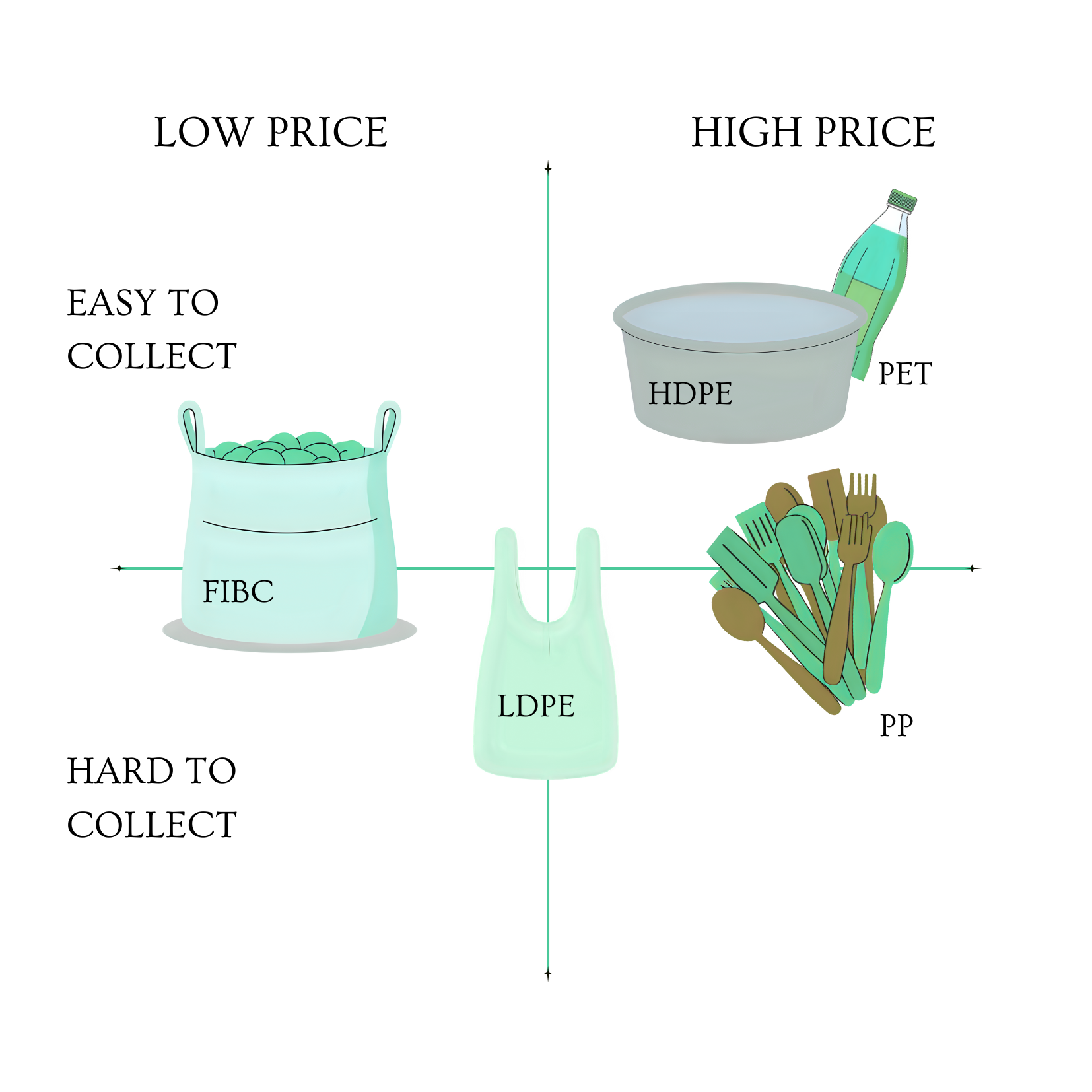
Tackling the ‘hard to recycle’
In many countries in the global south, municipal waste systems are unable to cope with increasing volumes of consumer and business waste, including plastic. The informal waste sector - individuals who collect, sort and clean waste for a living - is essential to managing waste.
Waste pickers work in difficult, dangerous environment. They do laborious, physical work and are often exploited by unscrupulous brokers. They might earn $1 per day, and their income is often uncertain, reliant on unreliable middlemen and word-of-mouth deals.
Given these conditions, waste pickers will focus on collecting the materials that are easiest to collect and give them the highest price per kg.
For example, PET (polyethylene terepthalate) is the highest value and most prevalent type of recyclable plastic in Maputo. PET waste takes the form of water and soda bottles ranging from 250ml to 2L. The bottles are easy to collect and WPs prize them above all other types of plastic.
We pay a 9% ‘top up’ over the market price for PET.
LDPE (low-density polyethylene) is the least collected recyclable plastic in Maputo, found in thin bags and packaging wrap. White/clear LDPE has higher value, while coloured LDPE has less value. Collection is hard due to mixing with other waste, accumulating dirt and low per-item weight.
We pay a 40% ‘top up’ over the market price for LDPE.
What we collect
PET - Polyethylene terepthalate
A lightweight, flexible plastic, commonly used for water or soft drinks bottles. This is relatively easy to collect and buyers tend to pay higher prices for PET.
HDPE - High density polyethylene
Rigid and durable plastics. HDPE is used for things like water butts, furniture, pipes, washing tubs, shampoo bottles.
PP - Polypropylene
PP is durable with some flexibility, often used for used for bottle caps, utensils, food containers.
LDPE - Low density polyethylene
A soft, flexible material commonly used for thin plastic bags and food wrapping. In the UK, you'll see 'soft plastics' containers outside supermarkets where you can return your LDPE bags and packaging. This is harder to collect from landfill and clean so we offer waste pickers a higher rate per kg to encourage collection and recycling of LDPE.
HDPE/PP - High density polyethylene mixed with polypropylene
Some buyers will accept mixed collections of HDPE and PP. This is convenient for waste pickers, as plastic waste made from these two polymers is quite difficult and time-consuming to distinguish and separate.
PP FIBC - Polypropylene flexible intermediate bulk containers
Large, strong bags made of woven PP. Used for bulk packaging of dried food stuffs. In the UK, you'll see them used to transport gravel and rubble or garden waste.
These don't fetch a great price from local recyclers so we offer waste pickers a higher rate per kg.